Author: Angharad Downing
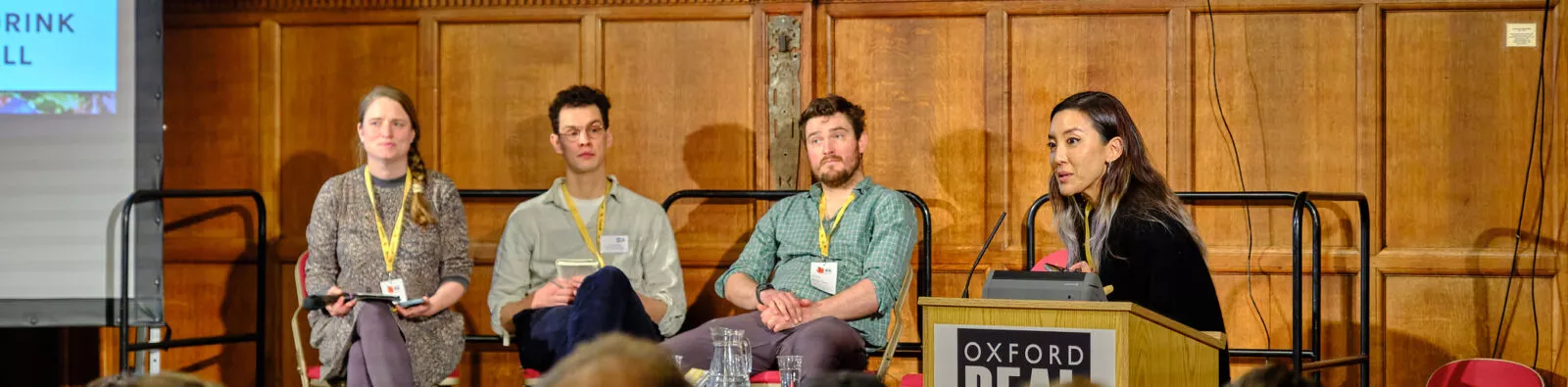
Despite being the lifeblood of agriculture, Earth’s soils are, in many ways, uncharted territories for modern science. The soil science discipline tasks itself with prying open the inner workings of soil systems, but does so in the dark: high-resolution data is scarce. Therefore, technological innovation for mapping and monitoring our soils offers fresh insight, and ORFC 2026 witnessed three researchers at the disciplinary forefront (Alex Park, Joe Collins, and Josiah Judson) share their experiences and hopes for the future.
Below are outlined two pillars in the emerging landscape of soil research, and their intersecting prospects for robust and timely enquiry.
Soil as scientific enquiry
Alex Park set the stage with Biofonic, a technology using finely-tuned acoustic sensors to explore the biological dimension of soil health. Applying AI to field data analysis, they have developed species identification models (such as for earthworms and cabbage stem flea beetles) from unique acoustic ‘fingerprints’. Joe Collins from the Earth Rover Program then explained the core principle of ‘soilsmology’: seismology applied to the Earth’s topsoil and subsoil layers. Their sensors record the way mechanical waves move through soil to illuminate structural features such as stratification and bulk density. On the farm-scale, Earth Rover technology could pinpoint areas of compaction and the depth of necessary cultivation. Finally, Josiah Judson introduced the AI4SoilHealth project, which aims to co-design a digital map representation of Europe’s soils to inform benchmarks for soil health.
A vision for this area will be constructing ‘digital twins’; virtual replicas of soil ecosystems used to simulate future environmental scenarios, enabling prepared and proactive agricultural management. This vast frontier of new discovery is exciting, and the mood is one of potential. Where traditional monitoring methods may be patchy and vulnerable to environmental change, high-tech innovations promise us efficient, uniform means of tracking soil health across continents.
Soil as lived experience
Soil is indeed mysterious to many of us, but it is known intimately by those who work with it. Beholding, feeling its weight in the hands; the textures and smells of a living system. Why trust an AI model to tell you what you, as a farmer, might intuitively know? Concerns surround the risks of distilling lived experiences down to data points in a lab, far removed from their fields of origin.
In this technological age, we must ask tricky questions: do we innovate for the sake of it? Or rather, do these cutting-edge methods sufficiently align with practical farm-scale decision-making priorities?
Intersecting prospects for on-farm decision-making
Farmers possess vast, versatile knowledge of the land, and it would be a mistake for soil science technology to consolidate itself without their inputs. The benefits of co-designed, participatory research are seen on both sides:
- Because input quality determines model performance, data collection must partner with farmer insight for essential ground truth.
- These technologies constitute another tool in the farm-system toolbox: they must augment, not replace, human decision-making capacities.
Accessibility and affordability is paramount so no part of the diverse UK farming community is cordoned off from technological engagement. Biofonic, for example, prioritises the low-cost collection of data, tailored to individual farm systems. Furthermore, both the Earth Rover Program and AI4SoilHealth aim to make available accessible digital toolkits in mobile app formats.
Volatile futures
With each season, farmers navigate new waters of unpredictable weather, pests and diseases. However, currents are shifting entirely as we enter a new era of climatic variability. AI models may therefore become a crucial element in the farm decision-making toolbox by bridging what we do and don’t know, simulating agricultural system behaviour in potentially volatile futures.
In these uncertain scenarios, data collected by any monitoring method cannot be a clear window to reality, and future large-scale policy decisions should not be founded on these points alone. They must instead be rooted in an integrated, participatory framework, and these trailblazing innovations should be used to spark conversations on what UK soil health priorities ought to be.
About the author: Angharad Downing is a BA Geography student at the University of Oxford with an interest in sustainable agriculture and climate science. As Undergraduate Student Representative in the British Ecological Society Agricultural Ecology Committee, she is keen to engage fellow students in the BES vision that reciprocal land relations are key to transforming conventional agriculture.
To learn more, check out this session in the ORFC archives.
Feeling inspired to share your ideas about soil science and farming topics? Don’t miss your chance to submit a proposal or idea for ORFC 2027 – you can find out more by checking out our ORFC Session Submission Guide.